
What Is Local SEO? A Practical Guide to Local Search
Local SEO is the process of making a business easier to find when people search for nearby products, services, or places. It connects your business information, Google Business Profile, website, reputation, and local search visibility so customers can find and evaluate you when location matters.
This guide focuses mainly on Google's local Search and Maps system because that is where most of the workflow below takes place. Local discovery also happens through other services, which we cover briefly later.
Local SEO in brief
- Make the business information customers depend on accurate.
- Help search engines and customers understand what you offer and where you operate.
- Build useful website information and genuine reputation signals.
- Measure local visibility separately from actual customer and business outcomes.
- Improve one well-defined problem at a time instead of chasing every ranking tip.
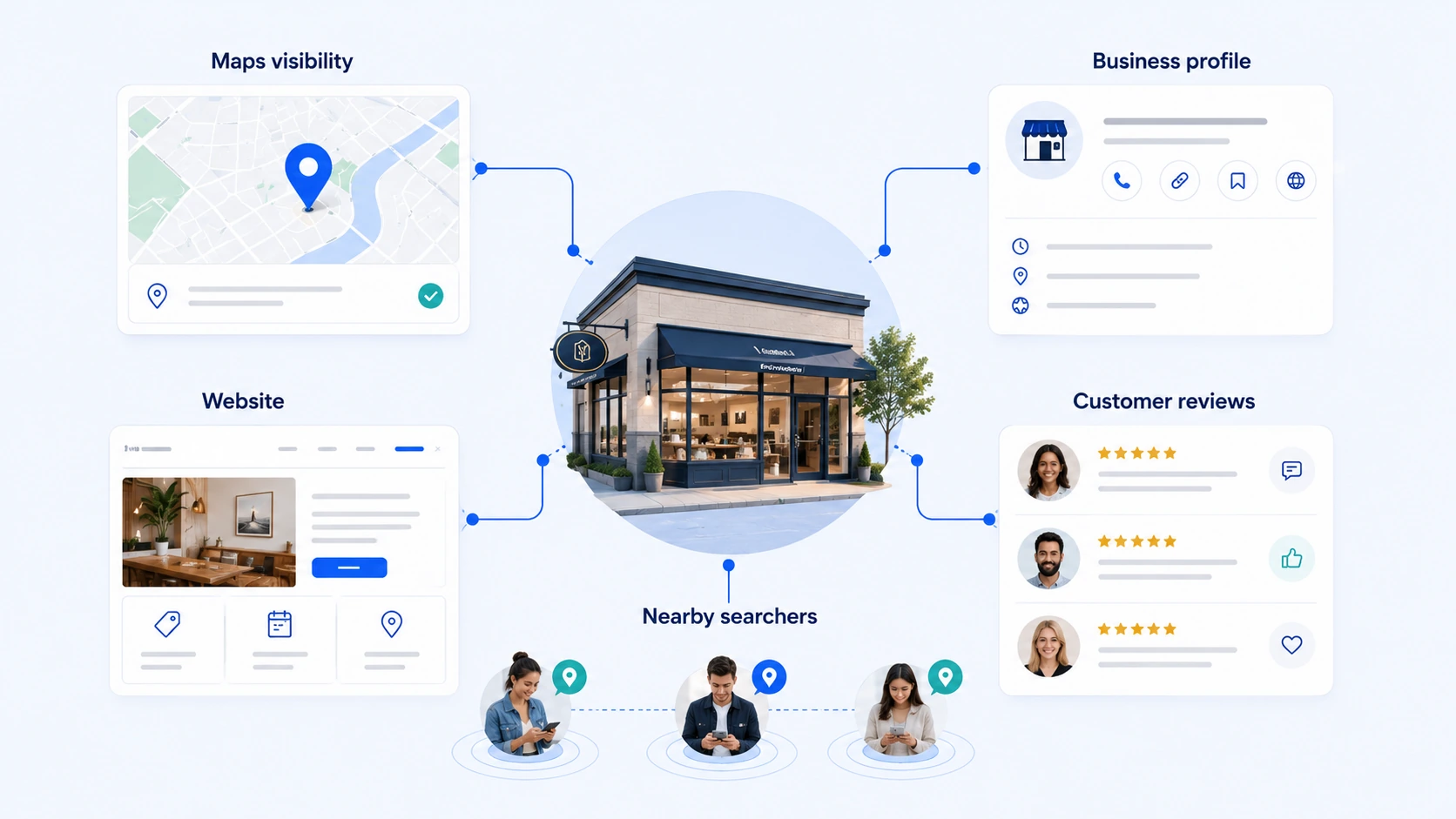
What local SEO actually means
Search engine optimization, or SEO, helps search engines understand online content and helps people discover it through search. Local SEO applies that work to searches where location affects which businesses are useful to the person searching.
That includes searches containing a city, neighborhood, or other place name. It also includes searches where the search engine decides that nearby businesses are relevant even though the person never types a location.
Local SEO can influence several parts of your search presence. Your Google Business Profile can appear in Google Search and Maps. Your website can appear in organic results. Reviews, links, business listings, and other information across the web can also help establish what the business is and where it operates.
What is a Google Business Profile?
A Google Business Profile is the listing an eligible business can claim and manage on Google Search and Maps. After verification, the business can manage supported information such as its category, address or service area, hours, phone number, website, photos, services, and other customer-facing details.
The profile is separate from your website. The website provides more room to explain services, locations, proof, policies, and next steps while earning its own organic visibility. The Business Profile manages information that can appear directly in Google's local Search and Maps experiences.
Local SEO is not regular SEO with a city name added. Geography changes the search environment itself. A business can be relevant to a search and still have different visibility depending on where that search takes place.
How does local SEO work?
Local search results are influenced by three main factors: relevance, distance, and prominence. Relevance reflects how well a business matches the search; distance considers how close the business is to the location involved in the search; and prominence reflects how established or well-known the business appears to be.
Does the business match the search?
Categories, services, profile information, website content, and other business details help establish what the business offers and which searches it may be relevant to.
How far away is the result?
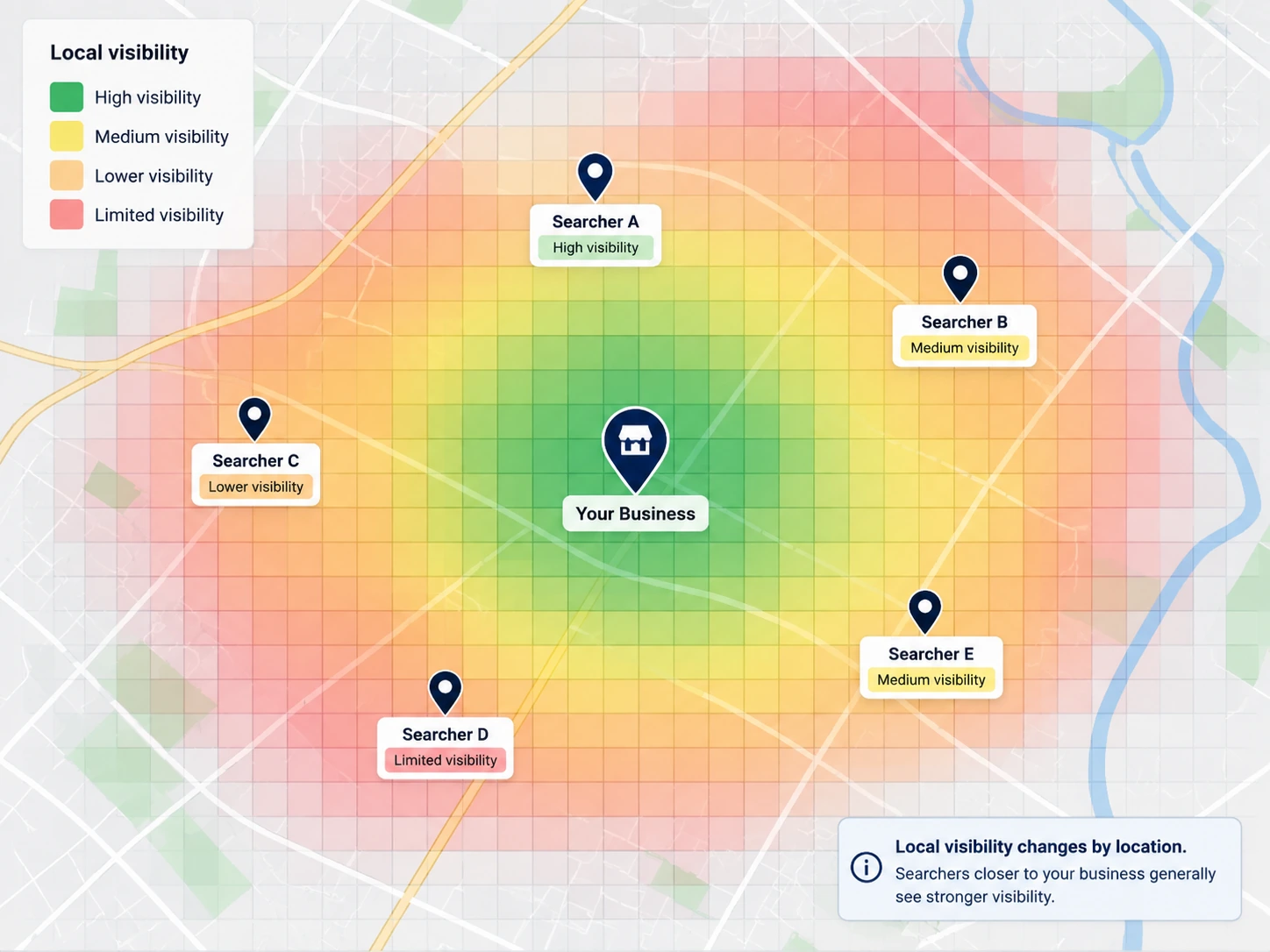
Distance considers the location involved in the search. Because of that geographic component, local visibility can vary across the same city or service area.
How well known is the business?
Google currently provides examples that include websites linking to the business and reviews. It does not publish a complete weighting formula for local prominence.
Google's local-ranking guidance also states that there is no way to request or pay for a better unpaid local ranking.
That is why precise charts claiming that one local ranking factor is worth an exact percentage should be treated carefully. A third-party study can identify patterns without revealing Google's private ranking formula.
How should you judge local ranking advice?
Use three checks before allowing a study, video, tool, or consultant recommendation to change your plan:
- Check the source. Is the claim based on Google's documentation, a third-party study, or one person's result?
- Define the problem it should solve. Connect the action to relevance, accurate business information, customer decision-making, prominence, website visibility, or measurement.
- Decide how you will evaluate it. Record a baseline and avoid changing several major things at the same time.
If a ranking tip cannot pass those checks, it should not push accurate business information or an obvious customer problem out of the priority list.
What kinds of businesses need local SEO?
Local SEO matters most when location affects whether a customer would choose the business.
That includes storefronts, restaurants, professional offices, local retailers, appointment-based businesses, and service-area businesses that travel to customers. Multi-location brands also need location-level information because each eligible location operates in its own local search environment.
A company selling nationally with no meaningful local customer relationship may have less reason to make local SEO a primary strategy.
Why local SEO matters for small businesses
Local SEO helps a business become easier to discover when people are already searching for something nearby. A Business Profile can provide useful information to help the searcher decide before they reach the website, including hours, contact information, photos, reviews, and location or service area details.
This makes local SEO especially useful for capturing existing local demand . It does not create demand by itself.
What do you actually need to start?
You do not need to launch every marketing channel at once.
For an eligible local business, start with one accurate local identity. Control the correct Business Profile, keep public business information accurate, and provide customers with a reliable way to call, contact, visit, book, or take the appropriate next step.
A website becomes more important when customers need deeper information, when separate services or locations need their own explanations, or when you want the site to earn its own organic search visibility.
Social media does not need to become another startup requirement because it exists. Assign it a specific job before adding it to the workload.
Local SEO vs. organic SEO, Google Ads, and social media
These channels can support the same business without doing the same job.
| Channel | Main job | How visibility is obtained | Best fit |
|---|---|---|---|
| Local SEO | Help a business appear when location matters to the search. | Improve the information and signals that support unpaid local and localized organic discovery. | People already search locally for the business, service, product, or category. |
| Broader organic SEO | Help website pages appear for relevant searches more broadly. | Improve useful content, crawlability, site structure, links, and other organic search factors. | The topic or question does not depend on one local market. |
| Google Ads | Buy eligible advertising exposure in Google. | Fund advertising campaigns and control campaign budgets. | You want paid exposure and direct control over advertising spend. |
| Social media | Publish content, maintain audience relationships, and reach people on social platforms. | Build organic audiences or pay for social distribution. | You want awareness, engagement, repeat contact, or discovery outside an active local search. |
Why your website and Google Maps can rank differently
A website result and a Business Profile result are different search surfaces. Google discovers, crawls, and indexes website pages for organic Search. Local results also apply location-specific considerations.
A strong website position does not require the Business Profile to hold the same position in Maps, and the reverse is also true.
Keep the measurements separate. Search Console measures website performance in Google Search. Business Profile performance measures activity associated with the profile on Search and Maps.
Local SEO beyond Google
Google is the main focus of this guide, but local business information also appears in other discovery services.
Bing Places for Business lets businesses claim or update listings that can appear in Bing Maps and search experiences. Microsoft also supports adding and managing business information through Bing Places.
Apple's local business tools are now part of Apple Business . Apple announced the new service in March 2026 and moved brand-management tools previously available through Apple Business Connect into Apple Business.
You do not need a separate SEO strategy for every search service before fixing the basics. Accurate business information is the common starting point.
Use Protect–Prove–Test to prioritize local SEO
A beginner does not need several competing SEO prioritization systems. Use three types of work instead: Protect, Prove, and Test.
Protect what customers depend on
Keep hours, phone numbers, website links, locations, service information, Business Profile access, and contact or booking paths accurate.
If one of those is wrong, fix it before starting an optional optimization project.
Prove one missing customer answer
Use real customer questions and search evidence to find information that the current profile or website does not answer fully.
Improve the existing page or profile information that should answer the need before automatically creating another URL.
Test one uncertain idea
For work where the outcome is uncertain, record the observation, make one meaningful change, and choose the evidence you will review next.
Avoid stacking several unrelated changes into one experiment.
Park everything else
Keep a separate parking list for new SEO ideas. Move a tactic into active work only when it does at least one of these jobs:
- corrects information that could mislead a customer;
- answers a customer or search need you can identify;
- tests a specific question with evidence you can review.
This prevents every new ranking tip, tool, or tactic from becoming an emergency.
| Business model | Protect first | Prove next | Test when ready |
|---|---|---|---|
| Storefront | Address, hours, entrance details, phone number, Business Profile, and contact path. | Service, product, location, booking, or policy information customers regularly need. | Changes to pages, calls to action, local visibility, or other uncertain improvements. |
| Service-area business | Profile eligibility, hidden address when required, correct service areas, phone number, and website. | Clear information about real services and markets served. | Location-page improvements, visibility measurements, and other changes whose outcome is uncertain. |
| Multi-location business | Accurate information and access for every eligible location. | Useful location-specific information where customer needs differ. | Location-level changes measured separately rather than assuming one market represents the rest. |
How to do local SEO yourself
The Protect–Prove–Test method tells you how to choose work. The steps below show how to build the foundation.
Claim, verify, and configure your Google Business Profile
Confirm that the business qualifies for a profile, that you control the correct listing, and that the profile is verified. Verification establishes your ability to manage the profile. It does not guarantee a particular ranking.
Check the primary category, real business name, address or service area, phone number, website, regular hours, special hours, services, and useful current photos.
Choose the most specific category that accurately represents the core business. Do not use categories or the business-name field as extra keyword fields.
Clean up important business information
Your public business name, address when applicable, phone number, website, and other customer-facing details should not conflict across important listings and your own website.
A citation is a mention or listing of business information on another website. A backlink is a clickable link from another website. They can occur together, but they are not the same thing.
Treat citation work as cleanup before expansion. Correct important listings that already contain bad information before spending hours looking for more directories.
Google does not publish a required citation count. Once important information is reliable, another unresolved customer or measurement problem may deserve your time more than another directory submission.
Find the searches and questions you need to answer
Do not begin by producing every possible combination of a service and city. Start with three fields: service, location, and search need.
List the services you actually provide using language customers understand. Add only markets you genuinely serve. Then identify what the searcher needs to accomplish, such as learning, comparing, finding a location, contacting the business, booking, buying, or solving a specific problem.
If the website already receives Google traffic, use Search Console to review queries that produce impressions and clicks.
Group searches that need the same answer. A slight keyword variation does not automatically deserve another page.
Build pages around real customer needs
Create a separate URL when the reader needs enough distinct information to justify one.
Page type Create a separate page when... Home You need a clear overview of the business and paths to its main services or locations. Service A service has distinct questions, details, proof, or next steps that deserve a complete answer. Location A real location or market needs information meaningfully different from other location content. Contact or location details Customers need clear instructions for visiting, calling, booking, or understanding where service is available. Resource A recurring customer or search question needs more depth than fits comfortably on another page. A one-page website can remain one page when it directly answers the business's main customer needs.
Do not create near-identical city pages that mainly swap place names. Create local pages where geography changes the information customers actually need.
Publishing content only to keep a blog active is not a separate Local Pack shortcut. Create another resource when there is a real question worth answering.
Build a neutral, repeatable review process
Choose a consistent point in the customer process for requesting a review after a genuine interaction is complete.
Google prohibits incentives for reviews, discouraging negative reviews, selectively soliciting positive reviews, pressuring customers for a rating, and requesting specific review content.
That means a private feedback question should not become a gate that sends satisfied customers to Google while withholding the same opportunity from dissatisfied customers.
Use the Google review link or QR code to reduce friction. Decide who sends the request, when it is sent, which link is used, and how the process is maintained.
Build legitimate local prominence
Useful links and mentions can come from real relationships, organizations, publications, suppliers, partnerships, sponsorships, or other parts of the local community and industry.
The useful question is not how many links you can buy. Ask where a legitimate reference to the business makes sense.
Business Profile posts can also communicate current information, offers, events, photos, videos, and links to customers. Treat posts as communication rather than as repeated keyword blocks.
Take a baseline before you keep changing things
Record the starting point before making several major changes. Keep website Search performance, Business Profile activity, website behavior, and business outcomes distinct enough that you know which question each measurement answers. Treat Google Business Profile optimization as measured maintenance, tying each change to one customer need or measurement question.
A simple monthly local SEO maintenance routine
You do not need a giant recurring checklist. A short review can keep the foundation healthy:
- check hours, contact information, website links, and important profile changes;
- review new customer feedback and respond where appropriate;
- inspect Search Console, Business Profile performance, and website results for meaningful changes;
- record major website or profile edits;
- choose one Protect, Prove, or Test action for the next cycle.
Storefront, service-area, and multi-location local SEO
Storefront businesses
A storefront should treat its physical location as part of the customer experience. The address, entrance, signage, opening hours, phone number, website, and profile photos should match what an arriving customer will actually find.
Maintain normal and special hours. Use current exterior photos that help customers recognize the location. Choose the most specific, accurate primary category and use relevant profile features when Google makes them available for the category.
Service-area businesses
A service-area business serves customers at their locations instead of receiving customers at a storefront.
If customers are not served at the business address, Google instructs the business to hide that address. P.O. boxes and remote mailboxes are not acceptable business locations, and Google's policies restrict virtual offices.
An eligible service-area business can still manage a Business Profile while keeping the street address hidden from customers.
Google currently allows up to 20 service areas and says the overall area generally should not extend beyond about two hours of driving time from where the business is based.
A larger service-area setting is not a ranking-radius control. The setting tells customers where the business serves. Distance remains part of the local-ranking system.
When an address should stay private, do not publish it only to make every third-party listing look identical. Keep the public business information you do use accurate instead.
Multi-location businesses
Every eligible location needs accurate information and should be evaluated in its own market context . A strong result for one location does not prove that another location has the same visibility, search demand, or business performance.
Create location pages where customers genuinely need location-specific information. Do not manufacture Business Profiles or near-duplicate pages simply to create extra map or search coverage.
What to update when the business changes
| Business change | What to coordinate |
|---|---|
| Business moves | Update the real address and related location information. Google says a verified business that moves to a new address must verify again. |
| Business name changes | Update the real-world name consistently across the Business Profile, website, and important listings. Do not use a rebrand as an excuse to insert ranking keywords. |
| Phone number changes | Update the Profile, website, contact pages, and important listings so customers do not encounter conflicting numbers. |
| Website URL changes | Update customer-facing listings and make sure the new website path works before removing the old one. |
| Hours change | Update normal or special hours anywhere customers depend on them. |
| New location opens | Confirm that the new location independently meets service eligibility requirements before creating a separate profile. |
Does local SEO work, and how do you measure it?
Local SEO can improve how easily a relevant business is discovered in local Search and Maps results. It cannot guarantee a specific position, remove geographic limits, or create local search demand where none exists.
The useful distinction is demand capture versus demand creation . Local SEO can help a business capture searches that already exist. Other channels may still be needed when the business first needs to build awareness.
How long does local SEO take to work?
No reliable universal timeline exists. Different changes operate on different schedules, and Google does not promise that every optimization will produce a noticeable ranking change.
Website updates need to be crawled and processed. Reviews, links, demand, local conditions, and business changes develop over time. Important profile edits can also require review or verification.
Use different measurements for different questions
| Source | What it helps you understand | What it does not establish by itself |
|---|---|---|
| Google Business Profile performance | Profile views, searches, and supported customer interactions. | It cannot show whether every interaction came from unpaid local SEO or whether the person became a customer. |
| Google Search Console | Website impressions, clicks, pages, and queries in Google Search. | What a visitor did after arriving on the site or whether a lead became a sale. |
| Google Analytics | Website and app activity, traffic sources, and configured conversions or events. | The full reason why a local ranking changed. |
| Local ranking observations | Visibility from a particular search location, query, date, device, and search surface. | A single universal ranking for the entire market. |
| Business records | Qualified leads, appointments, purchases, revenue, or other actual outcomes the business records. | Which marketing change caused an outcome unless the evidence supports that conclusion. |
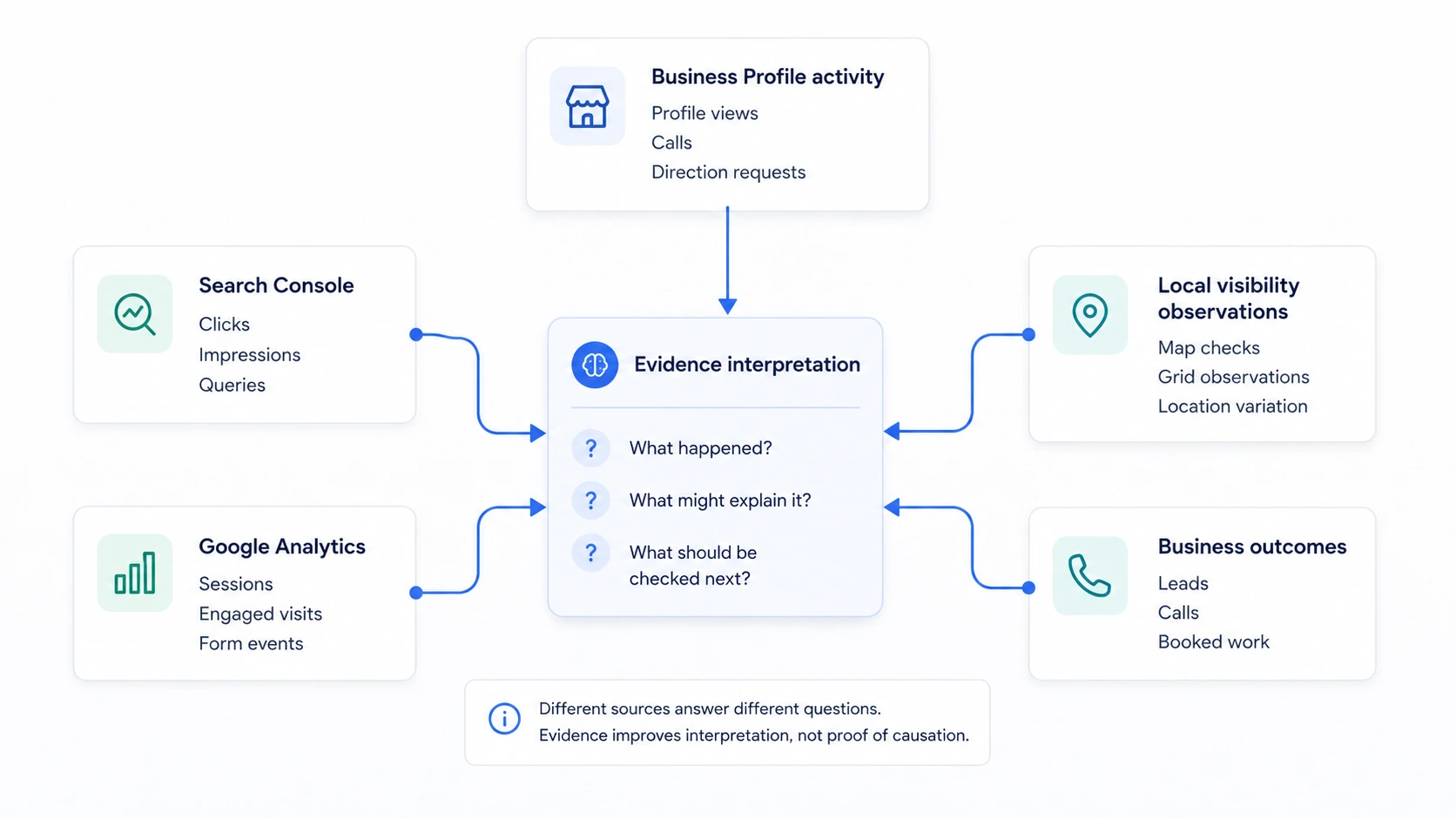
Important Business Profile caveat: Google states that Business Profile performance data can include views, searches, and actions from both organic results and Google Ads. Do not automatically label every Business Profile performance metric as an unpaid local SEO result.
Connect Business Profile activity with website outcomes
In June 2026, Google added a direct integration between Google Business Profile and Google Analytics. Eligible users can link Business Profiles to an Analytics property from the Analytics Admin area.
The integration can bring Business Profile metrics such as interactions, phone calls, bookings, direction requests, and website clicks into the broader Analytics reporting workflow .
Google's Business Profile linking documentation explains the current setup process.
The connection is useful because it brings related measurements closer together, but it does not erase their definitions. A Profile interaction is still not the same thing as a website conversion or completed sale.
When your local SEO numbers disagree
Search Console, Business Profile performance, Analytics, manually recorded rankings, and your own customer records answer different questions. Different numbers do not automatically mean one tool is wrong.
Check the measurement surface, date range, location, metric definition, and comparison period before treating a difference as a problem.
| What you observe | What deserves investigation |
|---|---|
| Visibility improves, but customer actions do not. | Check the offer, reviews, photos, hours, profile information, and landing-page experience. |
| Customer actions improve, but qualified leads or sales do not. | Check lead quality and what happens after the search, including phone handling, booking, checkout, or sales follow-up. |
| Website Search performance drops, but the Business Profile appears stable. | Investigate the website Search change in Search Console rather than assuming the Business Profile caused it. |
| Local visibility changes only from certain parts of the market. | Check the search location before treating the movement as a market-wide ranking change. |
| Relevant local search demand is small. | Do not force local SEO to carry the entire acquisition plan. Evaluate other channels too. |
Missing evidence is not a measured zero. If call tracking, form tracking, Analytics, or a useful baseline is unavailable, record the limitation instead of claiming that local SEO produced no result.
Use a decision log for uncertain changes
For test work, record enough context to learn from the change:
| Field | What to record |
|---|---|
| Date | When you noticed the issue or made the change. |
| Question | The specific problem you are trying to solve. |
| Surface | Website Search, Local Pack, Google Maps, Business Profile performance, or another measured surface. |
| Location | Where the local observation was made when location affects the measurement. |
| Evidence | The metric, query, page, profile information, or business outcome that exposed the problem. |
| Action | The meaningful change you decided to make. |
| Review point | The evidence you will check before making another related change. |
Local SEO mistakes that waste time
Changing several major things at once
A before-and-after result can show movement. It does not automatically prove which change caused that movement. This is why Test work should be narrow enough to interpret.
Measuring one ranking from one location
Distance affects local results. One search from one location provides one observation, not a complete view of local visibility .
Assuming an older domain automatically explains local rankings
Do not treat domain age as the automatic reason another business appears above you. Investigate the factors you can actually observe: relevance to the search, location, profile information, website content, reviews, links, and other evidence of prominence.
Making technical work the first priority because it looks complex
Structured data and other technical work can be useful, but complex-looking work does not automatically deserve the first hour.
LocalBusiness structured data can help Google understand business information on a website. It does not replace accurate visible information, an eligible Business Profile, useful pages, or genuine customer reputation.
Correct structured data also does not guarantee a particular search appearance.
Treating ranking movement as the business outcome
A better ranking can create more opportunity to be seen. It does not guarantee that the searcher will call, book, buy, or become a profitable customer.
Can you do local SEO yourself?
Many small businesses can handle the foundation themselves. The decision usually depends on time, technical comfort, the number of locations, measurement quality, and the risk of making an important change incorrectly.
What if you cannot code?
You can complete much of the local SEO foundation without touching code. You can manage Business Profile information, correct customer-facing details, identify services and markets, collect customer questions, ask for reviews, improve content in a supported website editor, and record a baseline.
Use a stopping rule for technical work. If a task requires editing theme files, DNS settings, redirects, tracking code, or structured data and you do not know how to reverse the change, put it on a separate technical list.
Complete the safe non-technical work first. Then use a supported website feature or get help with the technical change.
| DIY is more practical when... | Outside help becomes more practical when... |
|---|---|
| You manage one straightforward location. | You manage several locations with different pages, data, and markets. |
| Your Business Profile is verified and compliant. | Your profile is suspended, restricted, duplicated, or stuck in verification. |
| You can safely make the website changes you need. | Important work requires technical SEO, development, migrations, or complex CMS changes. |
| You can maintain reviews, information, and measurement. | The work repeatedly loses priority because business operations consume the available time. |
| You can connect basic marketing activity with useful business outcomes. | You cannot tell whether search activity is turning into qualified leads or customers. |
How much does local SEO cost?
Local SEO has no single required price because it can combine free first-party tools, internal labor, software, website work, content, development, and professional services.
| Cost layer | What it covers | When it becomes relevant |
|---|---|---|
| No-cost first-party foundation | Google Business Profile, Google Search Console, and the standard Google Analytics product. | Most beginners should establish the useful free foundation before buying additional software. |
| Your time | Profile updates, review workflows, website edits, content, measurement, and maintenance. | DIY becomes expensive when it repeatedly displaces higher-value business work. |
| Software | Tools that reduce manual monitoring, organization, measurement, or analysis. | When you can name the workflow problem the tool should solve. |
| Technical work | Development, migrations, tracking, structured data, or changes outside your skill set. | When the required change cannot be completed safely in-house. |
| Professional help | Strategy, execution, diagnosis, or ongoing management. | When the problem is important, specialized, or too time-consuming to handle internally. |
When is paying for local SEO help worth it?
Outside help has a clearer purpose when you can name the problem it needs to solve.
Before giving someone access to your website, Business Profile, Search Console, Analytics, or other systems, ask:
- What exactly will you change?
- Which accounts do you need access to, and why?
- Which Google guidelines will you follow?
- How will the work be measured?
- What results are realistic, and what cannot be guaranteed?
- How will changes be documented?
- Who keeps ownership of the accounts and completed work?
Red flag: Google states that no SEO provider can guarantee a number-one Google ranking. Its guidance for hiring an SEO recommends understanding what the provider plans to do and how success will be measured.
What tools should a beginner start with?
Start with first-party tools. Add another tool when it solves a specific measurement or decision problem.
| Tool | Use it for | When it becomes useful |
|---|---|---|
| Google Business Profile | Manage eligible business information that appears in Google Search and Maps. | From the beginning. |
| Google Search Console | Measure website Search impressions, clicks, pages, and queries. | As soon as the website is live. |
| Google Analytics | Understand website and app activity and configured outcomes. | When you need to connect traffic with what happens after the visit. |
| Vicin | Bring local SEO and marketing evidence into a connected process for interpretation, opportunity evaluation, and supported action. | When the harder problem is deciding what several measurements mean together and what deserves attention next. |
Local SEO questions beginners still ask
What is the Google Local Pack?
The Local Pack is the common SEO term for the map-based group of local business results Google may show when a search has local intent. It is different from the standard organic website results that may appear on the same results page.
What does NAP mean in local SEO?
NAP stands for name, address, and phone number. The term is commonly used when discussing core business information across a website, Business Profile, directories, and other listings. A service-area business that should keep its street address private should follow platform rules rather than publishing the address only for NAP consistency.